
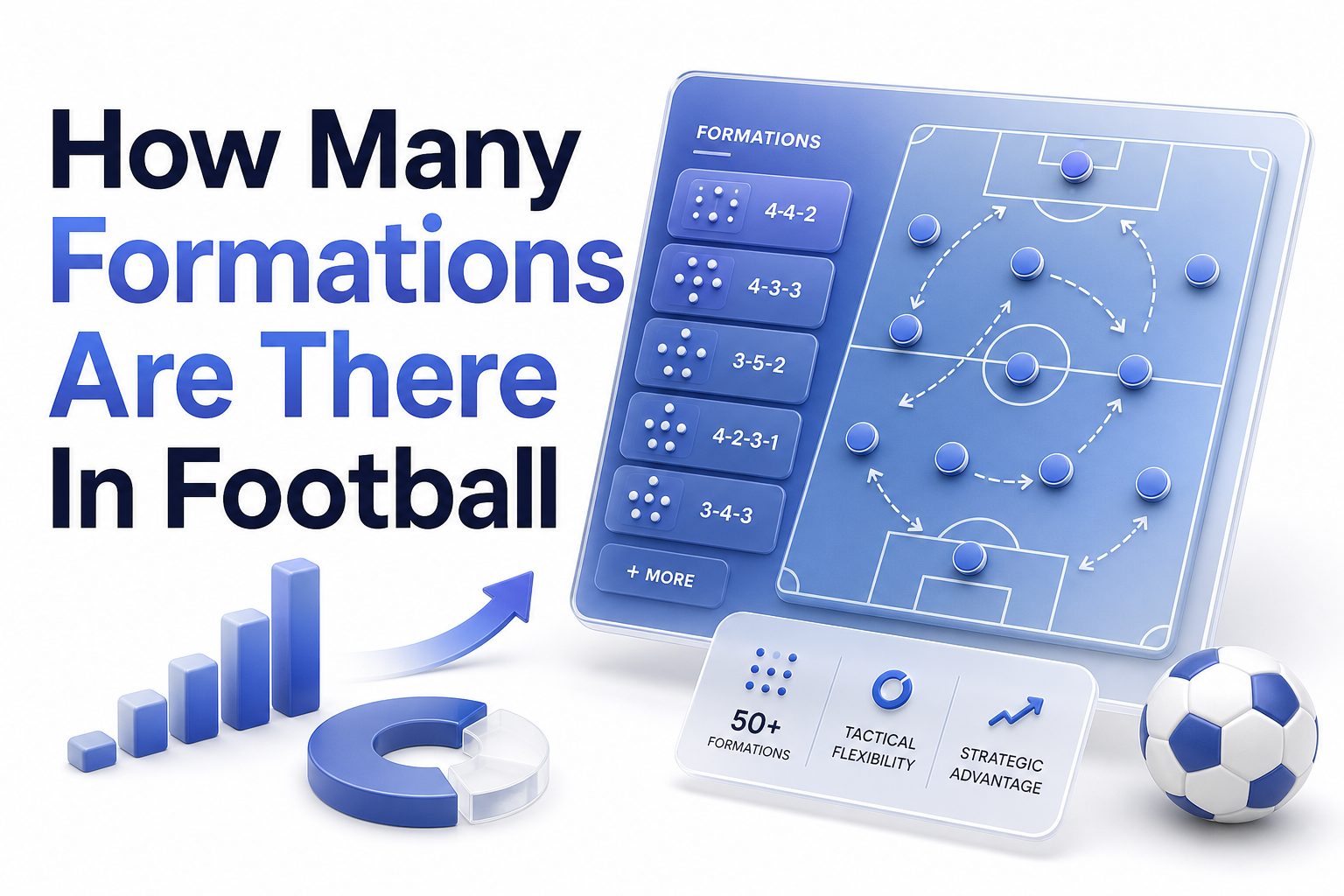
There is no fixed number of formations in football because coaches can arrange players in many legal ways. Still, most teams use systems built from familiar shapes such as 4-4-2, 4-3-3, 3-5-2, 4-2-3-1, and 5-3-2.
If someone asks how many formations are there in football, the practical answer is that there are dozens of common formations and hundreds of possible variations. The game allows flexibility, so formations change with tactics, player roles, and match situations.
A formation is usually written from defense to attack. For example, 4-3-3 means four defenders, three midfielders, and three forwards. Goalkeepers are not included because every team has one goalkeeper by rule.
Why Football Formations Are Not Limited
Football has eleven players, but ten outfield players can be placed in many different lines and roles. Because of that, formations are not restricted to a short official list. Coaches create shapes based on space, pressure, and team strengths.
A team may start in one formation and defend in another. A 4-3-3 can become a 4-5-1 without substitutions if wingers drop deeper. This makes counting formations harder because shapes shift throughout the match.
Modern football also uses hybrid roles. Full-backs may move into midfield, center-backs may step forward, and forwards may press like midfielders. These details create new versions of older formations without changing the written number.
Common Formation Families
Back four systems are the most familiar in modern football. They include 4-4-2, 4-3-3, 4-2-3-1, and 4-1-4-1. These shapes usually offer balance, clear defensive coverage, and strong options for wide attacking play.
Back three systems include 3-5-2, 3-4-3, and 3-4-2-1. These formations often use wing-backs to provide width. They can give teams an extra central defender while still supporting attacks on both sides.
Back five systems, such as 5-3-2 and 5-4-1, are often used for defensive stability. They can become attacking back three systems when wing-backs move forward, showing how one formation can carry multiple tactical identities.
Quick Formation Notes
4-4-2 gives balance and simple passing lanes.
4-3-3 supports pressing and wide attacking play.
4-2-3-1 offers midfield protection and creative freedom.
3-5-2 gives central strength and wing-back width.
5-4-1 helps teams defend deep and limit space.
4-4-2 Formation
The 4-4-2 is one of football’s classic formations. It uses four defenders, four midfielders, and two strikers. Its main strength is balance, with two clear banks of four supporting both defending and attacking phases.
This system works well for teams that value structure and direct play. The two strikers can combine closely, press center-backs, and attack crosses. Wide midfielders support full-backs while also delivering balls into the penalty area.
The 4-4-2 can struggle against teams with an extra central midfielder. If the opposition plays three midfielders, the two central midfielders may be overloaded. Coaches often solve this by asking one striker to drop deeper.
4-3-3 Formation
The 4-3-3 uses four defenders, three midfielders, and three attackers. It is popular because it gives teams width, pressing power, and several passing angles. Many possession-based teams use this shape to control the ball.
The midfield three usually includes one holding midfielder and two advanced central players. This structure helps teams build from the back while protecting central areas. The wide forwards stretch the pitch and attack spaces behind defenders.
A strong 4-3-3 needs energetic midfielders and disciplined wingers. If the wide forwards do not track back, full-backs can become exposed. When used well, it supports quick transitions, aggressive pressing, and fluid attacking movement.
4-2-3-1 Formation
The 4-2-3-1 is one of the most common modern formations. It uses two defensive midfielders, three attacking midfielders, and one striker. This gives teams a stable base while still allowing creative players to operate between lines.
The double pivot is the key feature of this system. Those two midfielders can protect the defense, recycle possession, and cover full-backs. Their positioning allows attacking players to take risks without leaving the team completely open.
This formation suits teams with a strong number ten or creative attacking midfielder. It also works well when wide players cut inside. For more tactical basics, a football positions guide can help explain how each role fits.
3-5-2 Formation
The 3-5-2 uses three central defenders, five midfielders, and two forwards. It is strong in central areas and allows two strikers to work together. Wing-backs provide width, making their fitness and timing very important.
This shape can be defensive or attacking depending on wing-back positioning. If wing-backs stay deep, it looks like a 5-3-2. If they push forward, the team can overload midfield and attack with numbers.
The 3-5-2 is useful against teams with two strikers because three center-backs can cover them well. However, it can be vulnerable in wide areas if wing-backs are pinned back or slow to recover.
3-4-3 Formation
The 3-4-3 has three defenders, four midfielders, and three attackers. It creates a strong attacking front line while keeping three center-backs behind the ball. Many teams use it to press high and attack quickly.
The wide players in midfield are usually wing-backs. They must support attacks, defend wide zones, and recover quickly. Because the formation asks so much from them physically, teams need players with excellent stamina and decision-making.
This system works best when the front three press together. If one attacker fails to close space, opponents can pass through the pressure. When coordinated, the 3-4-3 can create strong pressure and fast attacking chances.
5-3-2 Formation
The 5-3-2 is usually seen as a defensive formation, but it can still support quick counterattacks. It uses five defenders, three midfielders, and two forwards. The wing-backs are responsible for both width and defensive cover.
Teams often use this shape when facing stronger opponents. The three central defenders protect the penalty area, while the midfield three blocks central passing lanes. The two strikers stay ready to chase clearances and start counters.
A 5-3-2 can become too passive if the team sits too deep. Without support from midfield, the strikers may become isolated. The best versions still push wing-backs forward when possession is regained.
4-1-4-1 Formation
The 4-1-4-1 uses one holding midfielder between defense and midfield. Ahead of that player are four midfielders, with one striker leading the line. This setup helps teams protect central areas and stay compact.
The holding midfielder is vital because they screen passes into dangerous zones. They also help connect defense with midfield during build-up play. A smart player in this role can make the whole structure more secure.
This formation is often used by teams that want defensive discipline without giving up midfield numbers. It can become a 4-3-3 in attack if the wide midfielders push higher and support the striker.
4-5-1 Formation
The 4-5-1 is built for midfield control and defensive shape. It uses four defenders, five midfielders, and one striker. Teams often use it to reduce space, slow opponents down, and make central areas crowded.
This system can frustrate possession-heavy opponents because it creates many midfield bodies. Wide midfielders drop back to protect full-backs, while central players block passing lanes. The lone striker usually works hard to press and hold the ball.
The weakness is attacking support. If midfielders do not run forward quickly, the striker can become isolated. Successful teams using 4-5-1 need strong transition play and wide players who can carry the ball forward.
Attacking Versus Defensive Formations
A formation is not automatically attacking or defensive. The same shape can behave differently depending on player roles, pressing style, and risk level. A 4-3-3 can be aggressive, balanced, or cautious based on instructions.
Defensive formations usually protect central space and keep many players behind the ball. Attacking formations push more players into advanced areas. The difference often comes from movement rather than the written numbers alone.
Coaches choose formations to manage space. They may attack with five players and defend with nine. This is why formation labels are useful, but they never tell the full story of a team’s tactical plan.
Why Coaches Change Formations
Coaches change formations to match opponents, protect weaknesses, and use player strengths. A team with strong wingers may prefer 4-3-3, while a team with two quality strikers may choose 4-4-2 or 3-5-2.
Match situations also shape formation choices. A team protecting a lead may move from 4-3-3 to 5-4-1. A team chasing a goal may add another forward and switch to a more attacking setup.
Injuries, suspensions, and player fitness matter too. Coaches rarely choose formations in isolation. They look at available players, opposition threats, pitch conditions, and the type of control they want during the match.
How Formations Change During Matches
A starting formation is only the first shape. During a match, teams shift constantly depending on possession. A side may defend in 4-4-2, attack in 3-2-5, and press in 4-2-4.
These changes happen through player movement. A full-back may step into midfield, a winger may move inside, or a defensive midfielder may drop between center-backs. The written formation stays simple, but the real shape becomes layered.
This is why professional analysis often separates in-possession and out-of-possession formations. It gives a clearer view of how a team actually plays. For readers learning tactics, a soccer tactics guide can add useful context.
Youth Football Formations
Youth football uses fewer players in many age groups, so formations are different. Seven-a-side teams may use 2-3-1, while nine-a-side teams may use 3-2-3 or 3-3-2. These systems teach spacing and teamwork.
At younger levels, development matters more than rigid tactics. Coaches often choose simple shapes that help players learn passing angles, defensive recovery, and positional awareness. The goal is to build habits that transfer later.
As players move toward eleven-a-side football, formations become more detailed. Coaches introduce pressing triggers, build-up patterns, and role-specific responsibilities. Still, the best youth systems leave room for creativity and decision-making.
Professional Football Formation Trends
Modern professional football often favors flexible systems. Many top teams use a back four on paper but create a back three during build-up. This helps midfielders find space and supports controlled possession.
The 4-2-3-1 and 4-3-3 remain highly popular because they offer balance. They allow teams to press, protect central spaces, and attack through wide channels. Their flexibility makes them useful across many leagues.
Back three systems have also returned strongly in recent years. They help teams build under pressure and defend with extra central cover. The trend shows that football formations keep changing with coaching ideas and player profiles.
The Real Number of Football Formations
If counting only common senior eleven-a-side formations, there are around twenty to thirty widely recognized systems. These include variations of back four, back three, and back five shapes used across professional and amateur football.
If counting every possible legal arrangement, the number becomes much larger. Coaches can create hundreds of variations by changing player lines, role behavior, and movement patterns. Football has no official formation limit.
So, how many formations are there in football depends on how strictly you count them. For practical learning, focus on the main families first. Once those are clear, variations become easier to read during matches.
Conclusion
Football does not have one fixed number of formations. There are dozens of common systems and many more variations created through player movement, tactical roles, and match situations. The main shapes include 4-4-2, 4-3-3, 4-2-3-1, 3-5-2, and 5-3-2.
The best way to answer how many formations are there in football is to separate common formations from tactical variations. Common formations are easy to list, but real match shapes change constantly as teams attack, defend, and press.
Formations help explain structure, but they are only part of the game. Player quality, coaching ideas, teamwork, and decision-making all matter. A formation gives the starting shape, while the team’s movement gives it meaning.
Frequently Asked Questions
How many formations are there in football
There is no official fixed number. Coaches commonly use around twenty to thirty recognized eleven-a-side formations, but hundreds of variations are possible when player roles, movements, and tactical changes are counted.
What is the most common football formation
The 4-2-3-1 and 4-3-3 are among the most common modern formations. They give teams balance, midfield control, pressing options, and enough attacking width to create chances from different areas.
Is 4-4-2 still used in football
Yes, 4-4-2 is still used, especially by teams that want clear structure, two strikers, and strong wide play. It is less dominant than before but remains effective with disciplined midfielders and hard-working forwards.
Which formation is best for attacking football
The 4-3-3 is often linked with attacking football because it uses wide forwards, midfield support, and strong pressing options. Still, any formation can be attacking if players move forward with purpose and support each other.
Can a team change formation during a match
Yes, teams change formation during matches all the time. A side may defend in one shape and attack in another. Substitutions, scoreline, opponent pressure, and tactical instructions can all change the team’s structure.
0 Comments